
Coin Flip Probability Guide: Complete Mathematical Analysis
Master the mathematics behind coin flips with comprehensive probability calculations, statistical analysis, and real-world applications. From basic odds to advanced sequences.
Table of Contents
Coin flip probability forms the foundation of probability theory and statistical analysis. Whether you're a student learning mathematics, a gambler calculating odds, or a researcher running experiments, understanding the precise mathematics behind coin flips is essential. This comprehensive guide covers everything from basic 50/50 odds to advanced sequence calculations.
Basic Coin Flip Probability
The probability of any single coin flip outcome is straightforward, but understanding why requires examining the fundamental principles of probability theory.
The 50/50 Principle
For a fair coin, the probability of heads equals the probability of tails. This is expressed mathematically as:
P(Heads) = 1/2 = 0.5 = 50%
P(Tails) = 1/2 = 0.5 = 50%
This calculation comes from the fundamental probability formula:
P(Event) = Number of Favorable Outcomes / Total Possible Outcomes
For a coin flip: 1 favorable outcome (either heads or tails) divided by 2 total possible outcomes (heads or tails) = 1/2.
Why Fair Coins Are 50/50
A fair coin has equal probability for each outcome because:
- Symmetry: Physical coins are designed with equal weight distribution
- Independence: Each flip is an independent event unaffected by previous results
- Randomness: Initial conditions (force, angle, height) create unpredictable trajectories
However, research by Persi Diaconis shows physical coin flips have a slight bias (51% favoring starting side), though digital flips can achieve true 50/50 randomness.
Calculating Multiple Flip Probabilities
When flipping multiple coins, probability calculations become more complex but follow clear mathematical rules.
Independent Events Multiplication Rule
For independent events (like coin flips), multiply individual probabilities to find the probability of both events occurring:
P(A and B) = P(A) × P(B)
Probability Table for Multiple Flips
| Outcome | Number of Flips | Probability | Percentage |
|---|---|---|---|
| 2 Heads in a row | 2 | (1/2) × (1/2) = 1/4 | 25% |
| 3 Heads in a row | 3 | (1/2)³ = 1/8 | 12.5% |
| 4 Heads in a row | 4 | (1/2)⁴ = 1/16 | 6.25% |
| 5 Heads in a row | 5 | (1/2)⁵ = 1/32 | 3.125% |
| 10 Heads in a row | 10 | (1/2)¹⁰ = 1/1024 | 0.0977% |
Key Insight: Probability decreases exponentially. Getting 10 heads in a row is about 1 in 1,000—rare but not impossible.
Calculating Any Specific Sequence
The probability of any specific sequence of n flips is always:
P(specific sequence) = (1/2)ⁿ
This means HHHHH has the same probability as HTHTH or THTTH. Each specific sequence is equally likely, even though patterns may feel more or less random.
Understanding Streaks and Sequences
Streaks are consecutive identical outcomes. Understanding streak probability is crucial for gambling, statistics, and decision-making.
Probability of Getting At Least One Streak
The probability of getting at least one streak of length k in n flips is more complex:
Example: Probability of at least one 3-flip streak in 10 flips
This requires calculating all possible ways a streak can appear, accounting for overlaps. The approximate probability is about 44%.
Expected Number of Flips for a Streak
On average, how many flips does it take to see a specific streak length?
| Streak Length | Expected Flips | Real-World Meaning |
|---|---|---|
| 2 in a row | 6 flips | Very common, happens quickly |
| 3 in a row | 14 flips | Common in short sessions |
| 4 in a row | 30 flips | Noticeable but regular |
| 5 in a row | 62 flips | Memorable when it happens |
| 10 in a row | 2,046 flips | Extremely rare event |
Law of Large Numbers in Action
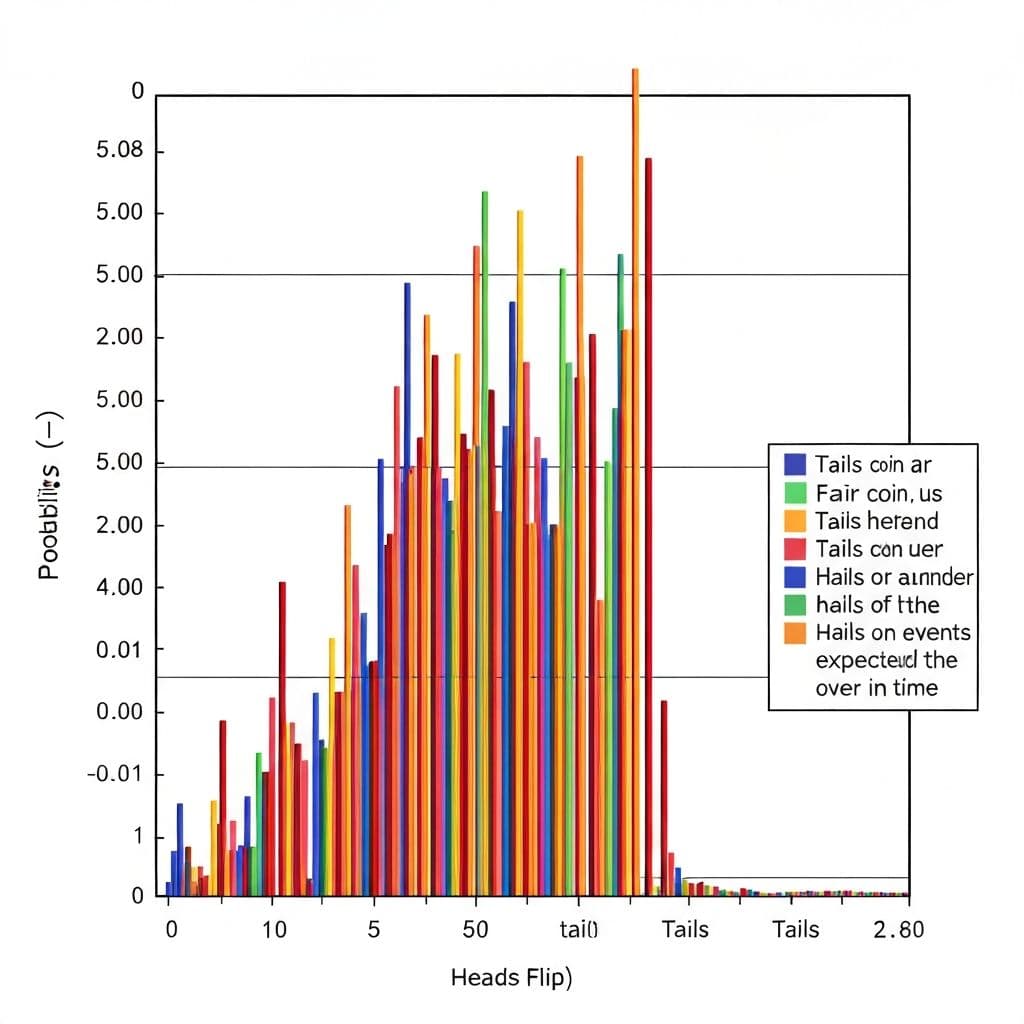
The Law of Large Numbers states that as sample size increases, actual results converge toward theoretical probability.
What This Means for Coin Flips
- 10 flips: Could easily be 7 heads, 3 tails (70% heads)
- 100 flips: Likely 45-55 heads (45-55% heads)
- 1,000 flips: Very likely 480-520 heads (48-52% heads)
- 10,000 flips: Almost certainly 4,900-5,100 heads (49-51% heads)
Test this yourself with our bulk coin flip tool. Run 1,000 flips and observe how results cluster around 50%.
Standard Deviation Formula
The standard deviation for n coin flips is:
σ = √(n × 0.5 × 0.5) = √(n) / 2
For 100 flips: σ = √100 / 2 = 5. This means results typically fall within 45-55 heads (one standard deviation from mean of 50).
Gambler's Fallacy Explained
The Gambler's Fallacy is the mistaken belief that past outcomes affect future probabilities in independent events.
Common Misconceptions
❌ WRONG Thinking:
"I've flipped 5 tails in a row, so heads is 'due' to come up next. My chance of heads is higher than 50%."
✓ CORRECT Thinking:
"I've flipped 5 tails in a row. The next flip still has exactly 50% chance of heads and 50% chance of tails. Past flips don't affect future flips."
Why This Matters
Understanding independent events prevents costly mistakes in:
- Gambling: Betting more after losses ("I'm due for a win")
- Investing: Assuming past performance predicts future results
- Decision-making: Over-weighting recent events in probability assessments
Real-World Applications
1. Sports and Competitions
Super Bowl coin tosses have been won by the NFC 30 times and AFC 28 times (as of 2024). Despite the slight imbalance, this falls well within expected statistical variance and doesn't indicate bias.
2. Scientific Research
Researchers use coin flip probability to calculate statistical significance (p-values). If an observed result is less than 5% likely to occur by chance, it's considered statistically significant.
3. Cryptography
Secure random number generators use principles similar to coin flips to create encryption keys. True randomness is critical for security.
4. Game Theory and Economics
Coin flips model binary decisions in game theory, helping economists understand strategic behavior and equilibrium outcomes.
Advanced Probability Concepts
Binomial Distribution
The binomial distribution describes the probability of getting exactly k successes in n independent trials with probability p:
P(X = k) = C(n,k) × p^k × (1-p)^(n-k)
For coin flips with p = 0.5, this calculates probabilities like "exactly 60 heads in 100 flips" (which is about 1.08%).
Conditional Probability
The probability of event A given that event B has occurred:
P(A|B) = P(A and B) / P(B)
Example: "Given that I flipped at least one heads in 3 flips, what's the probability I got exactly 2 heads?" This requires conditional probability calculations.
Expected Value
Expected value represents the average outcome over many trials:
Example: Coin Flip Betting Game
- Win $2 on heads (50% probability)
- Lose $1 on tails (50% probability)
- Expected Value = (0.5 × $2) + (0.5 × -$1) = $1 - $0.50 = $0.50 profit per flip
Practice Probability Calculations
Use our coin flip simulator to test these probability concepts in real-time. Run bulk flips and compare your results to theoretical predictions.
Test Probability Now →Frequently Asked Questions
What is the probability of getting heads on a coin flip?
For a fair coin, the probability of getting heads is exactly 50% (0.5 or 1/2). This is because there are two equally likely outcomes: heads or tails.
What are the odds of flipping 10 heads in a row?
The probability of flipping 10 heads in a row is (1/2)¹⁰ = 1/1,024, or approximately 0.0977%. This is about 1 in 1,024 attempts. While rare, it's not impossible and will occur eventually with enough flips.
Does the probability change after getting several tails in a row?
No. Each coin flip is an independent event with exactly 50% probability for each outcome, regardless of previous results. This misconception is called the Gambler's Fallacy.
How many flips until results converge to 50/50?
According to the Law of Large Numbers, results approach 50/50 as sample size increases. With 100 flips, expect 45-55 heads. With 1,000 flips, expect 480-520 heads. Perfect 50/50 is unlikely but results cluster closer as n increases.
What is the probability of getting exactly 50 heads in 100 flips?
Using the binomial distribution formula, the probability of exactly 50 heads in 100 flips is approximately 7.96%. This is the single most likely outcome, but getting exactly 50 is still relatively uncommon.
Are digital coin flips more random than physical flips?
Yes. Digital coin flips using cryptographically secure random number generators can achieve true 50/50 randomness. Physical flips have slight bias (≈51% toward starting side) due to physics and human factors.
How do you calculate probability for weighted coins?
For weighted (biased) coins with probability p for heads, use the same formulas but replace 0.5 with your actual p value. For example, a 60% heads coin: P(HH) = 0.6 × 0.6 = 0.36 (36%).
What is statistical significance in coin flip experiments?
Results are statistically significant if they're unlikely to occur by chance alone (typically <5% probability). For example, getting 65 heads in 100 flips suggests the coin might be biased, as this is statistically unlikely for a fair coin.