
How Random Are Online Coin Flips? Security & Algorithm Analysis
Understand the algorithms, cryptographic security, and testing methods behind online coin flips. Learn what makes digital randomness truly fair and trustworthy.
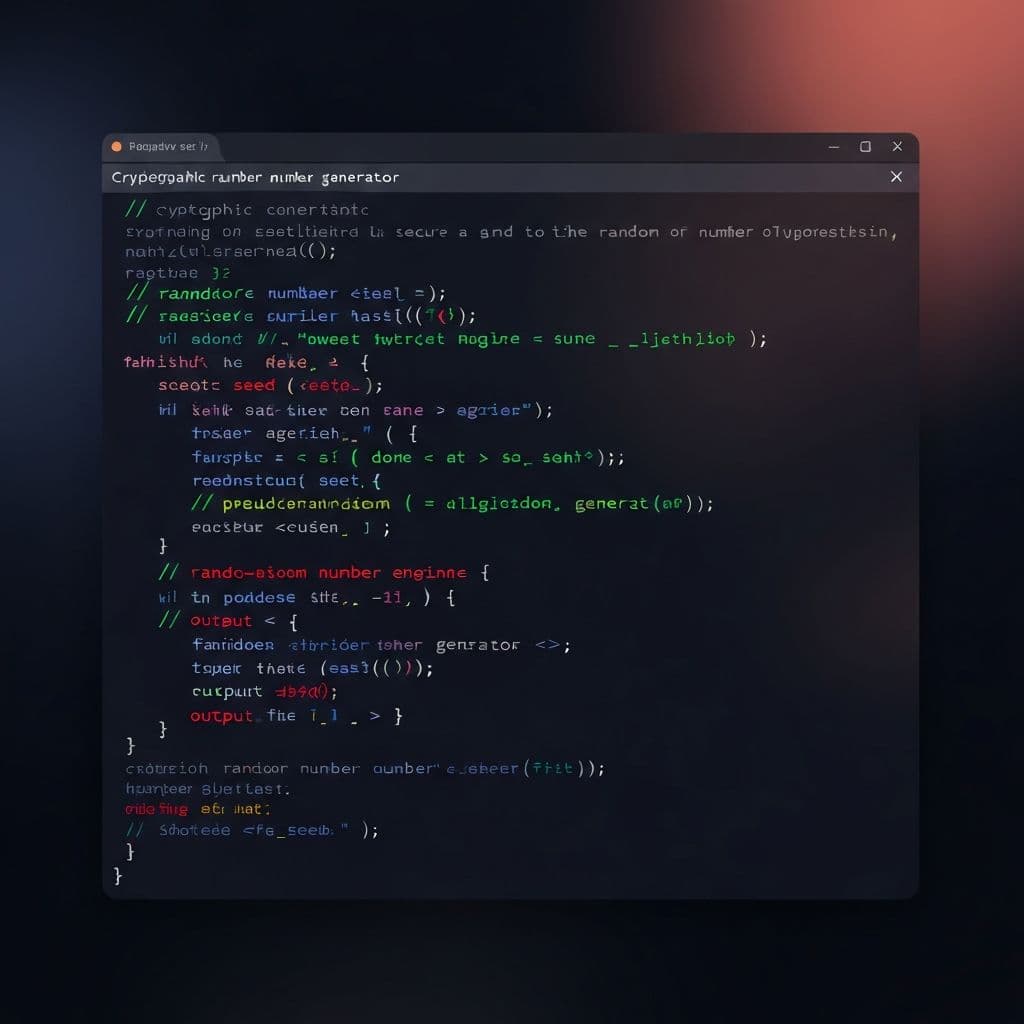
Table of Contents
When you click a button to flip a coin online, how can you trust the result is truly random? Unlike physical coins governed by physics, digital coin flips rely on algorithms and mathematical computations. This guide reveals the technology, security measures, and testing methods that ensure online coin flips are just as random—if not more so—than physical tosses.
True Random vs. Pseudo-Random
Understanding the difference between true randomness and pseudo-randomness is fundamental to evaluating online coin flip quality.
True Random Number Generators (TRNGs)
True random numbers come from unpredictable physical processes:
- Atmospheric noise: Using radio frequency background noise from the atmosphere
- Hardware entropy: Mouse movements, keyboard timing, system interrupts
- Quantum phenomena: Radioactive decay, photon behavior, quantum tunneling
- Thermal noise: Electrical resistance fluctuations in circuits
Services like Random.org use atmospheric noise to generate true random numbers. However, accessing true randomness adds latency and complexity.
Pseudo-Random Number Generators (PRNGs)
Pseudo-random numbers use mathematical algorithms to generate sequences that appear random:
- Deterministic: Same seed produces same sequence
- Fast: Generate millions of numbers per second
- Reproducible: Useful for debugging and testing
- Statistically random: Pass randomness tests despite being deterministic
The Key Question: Can pseudo-random be "random enough" for coin flips? The answer depends on the quality of the algorithm and the unpredictability of the seed.
| Feature | True Random (TRNG) | Pseudo-Random (PRNG) |
|---|---|---|
| Source | Physical processes | Mathematical algorithms |
| Predictability | Unpredictable | Deterministic but appears random |
| Speed | Slower (depends on physical process) | Very fast |
| Reproducibility | Cannot reproduce | Can reproduce with same seed |
| Use Case | High-security cryptography | General applications, simulations |
How Random Number Generators Work
Modern web browsers and programming languages provide built-in random number generators. Understanding their implementation reveals their quality.
JavaScript Math.random() (Insecure)
The most basic approach—but NOT suitable for security-sensitive applications or fair coin flips requiring trust:
// Basic approach (NOT recommended for sensitive uses)
function flipCoin() {
  return Math.random() < 0.5 ? 'Heads' : 'Tails';
}
Problems with Math.random():
- Implementation varies by browser
- Not cryptographically secure
- Potentially predictable with enough observations
- May have statistical biases in some browsers
Cryptographically Secure Random (Recommended)
Better approach using Web Crypto API for secure randomness:
// Secure approach using Web Crypto API
function secureCoinFlip() {
  const randomBytes = new Uint32Array(1);
  crypto.getRandomValues(randomBytes);
  return randomBytes[0] % 2 === 0 ? 'Heads' : 'Tails';
}
Why crypto.getRandomValues() is better:
- Cryptographically secure random number generation
- Uses operating system entropy sources
- Standardized across modern browsers
- Unpredictable even with previous outputs known
Cryptographic Security Explained
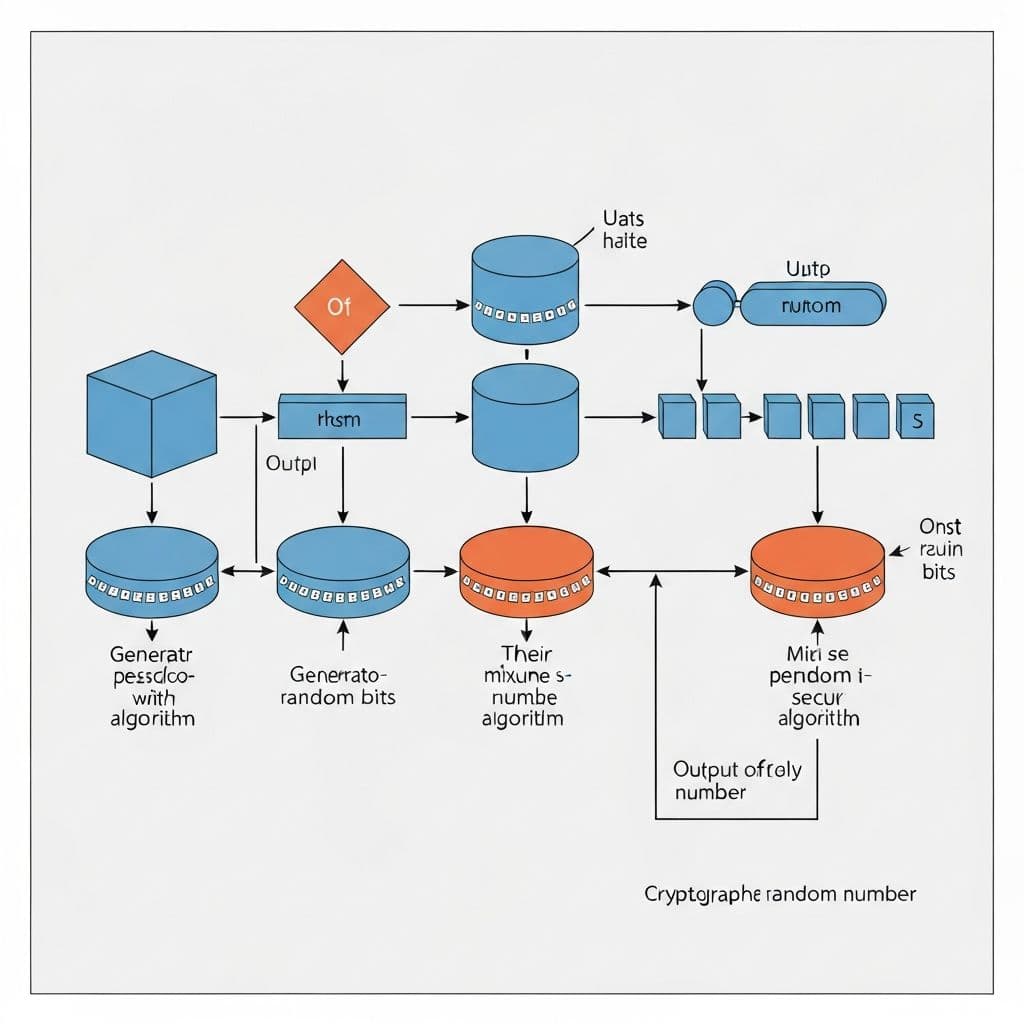
Cryptographically Secure Pseudo-Random Number Generators (CSPRNGs) meet strict requirements that make them suitable for security applications and fair randomness.
Requirements for CSPRNGs
- Next-bit test: Given n bits of output, cannot predict bit n+1 better than 50% chance
- State compromise: Even if internal state is revealed, previous outputs remain unpredictable
- Statistical uniformity: Output distribution is indistinguishable from true random
Common CSPRNG Algorithms
| Algorithm | Used In | Security Level |
|---|---|---|
| ChaCha20 | Modern browsers, Linux /dev/urandom | Very High |
| AES-CTR-DRBG | Windows, some browsers | Very High |
| Fortuna | macOS, iOS | Very High |
| Xoroshiro128+ | Some JavaScript engines | Medium (not cryptographic) |
Testing Randomness Quality
Several statistical test suites evaluate randomness quality. These tests detect patterns, biases, and non-random behavior.
NIST Statistical Test Suite
The NIST test suite includes 15 tests to assess randomness:
- Frequency test: Are 0s and 1s equally distributed?
- Runs test: Do expected run lengths appear?
- Longest run test: Is the longest run reasonable?
- Spectral test: Are there periodic patterns?
- Serial test: Are overlapping patterns uniform?
Chi-Square Test for Coin Flips
The chi-square test measures how well observed results match expected distributions:
χ² = Σ[(Observed - Expected)² / Expected]
For 1,000 coin flips expecting 500 heads and 500 tails, if you observe 520 heads and 480 tails:
χ² = [(520-500)²/500] + [(480-500)²/500] = 0.8 + 0.8 = 1.6
A chi-square value of 1.6 with 1 degree of freedom has a p-value of about 0.21 (21%), indicating results are consistent with randomness (p > 0.05 means no significant deviation).
Diehard Tests
The Diehard battery of tests, created by George Marsaglia, includes rigorous statistical tests designed to detect subtle biases in random number generators.
FlipACoinFree's Randomness Implementation
Our coin flip tool uses industry-standard cryptographic random generation to ensure fairness:
Our Implementation:
- Client-Side Generation: Uses browser's crypto.getRandomValues() for transparency
- No Server Bias: Randomness generated on your device, not our servers
- Statistical Tracking: Display long-term statistics to verify 50/50 distribution
- Open Algorithm: Transparent implementation you can verify
Verification Process
You can verify our randomness quality by:
- Running bulk flips (1,000+ flips) and checking the heads/tails ratio approaches 50%
- Exporting flip data as CSV and running your own statistical tests
- Observing that long-term statistics converge to expected theoretical values
- Testing for streaks and patterns that match probability theory predictions
Trust Through Transparency
FlipACoinFree generates randomness on your device using your browser's secure crypto API. No server manipulation, no hidden algorithms—just provably fair coin flips.
Flip Now →Common Pitfalls in Random Generation
1. Using Current Time as Seed
❌ BAD Practice:
// Predictable seed based on time
const seed = Date.now();
// This makes the sequence predictable
Using timestamps as seeds makes the sequence predictable since time values are guessable and have limited entropy.
2. Modulo Bias
Naive modulo operations can introduce bias:
❌ BIASED Approach:
// If random value is 0-255, this biases toward lower values
const biasedFlip = randomValue % 2;
If your random number range isn't evenly divisible by 2, modulo creates slight bias. The proper approach uses rejection sampling or bit-level operations.
3. Insufficient Entropy Collection
Random number generators need sufficient entropy (unpredictability) from system sources. On freshly booted systems or virtual machines, entropy pools may be depleted, potentially weakening randomness quality.
Comparing Online vs. Physical Coin Flips
| Factor | Physical Coins | Online Flips (Proper Implementation) |
|---|---|---|
| Fairness | ≈51% bias toward starting side | True 50/50 with CSPRNG |
| Speed | 2-3 seconds per flip | Instant, can generate thousands/second |
| Verifiability | Must trust physical observation | Can audit code and test statistically |
| Manipulation Risk | Skilled flippers can influence outcome | Cryptographically secure against manipulation |
| Accessibility | Requires physical coin | Available anywhere with internet |
Frequently Asked Questions
Are online coin flips truly random?
Yes, when properly implemented using cryptographically secure random number generators (CSPRNGs). FlipACoinFree uses the browser's crypto API, which provides cryptographic-quality randomness indistinguishable from true random for practical purposes.
Can online coin flip results be predicted?
No. Properly implemented CSPRNGs are designed so that even if you know all previous outputs, you cannot predict the next result better than random guessing (50% for coin flips). This is a core requirement of cryptographic security.
How can I verify an online coin flipper is fair?
Run bulk flips (1,000+) and check that results approach 50% heads and 50% tails. Export data and perform chi-square tests. Look for open-source implementations or transparent algorithms. Check if the site uses crypto.getRandomValues() rather than Math.random().
Is Math.random() good enough for coin flips?
For casual use, yes. For anything requiring trust, fairness, or security—no. Math.random() varies by browser, isn't cryptographically secure, and may have subtle biases. Always use crypto.getRandomValues() for serious applications.
Do online coin flips have any bias?
Properly implemented online coin flips using CSPRNGs have no measurable bias and achieve true 50/50 odds. This actually makes them fairer than physical coins, which research shows have a slight (≈51%) bias toward the starting side.
What is the difference between random and pseudo-random?
True random comes from unpredictable physical processes (atmospheric noise, quantum effects). Pseudo-random uses mathematical algorithms that appear random but are deterministic. However, cryptographically secure pseudo-random (CSPRNG) is indistinguishable from true random for practical purposes.
Can hackers manipulate online coin flip results?
Not when using client-side cryptographic random generation. Since FlipACoinFree generates randomness on your device using your browser's secure API, there's no server to manipulate. The code runs locally, making it transparent and tamper-resistant.
How do blockchain-based coin flips ensure fairness?
Blockchain-based random generation uses commit-reveal schemes, verifiable random functions (VRFs), or combining entropy from multiple participants. While highly secure, they're slower and more complex than needed for most coin flip applications.